The Representation Economy - Where Everyone Has an Agent
AI makes every signal perfect — and perfectly meaningless. What replaces it isn't better tools. It's representation: universal, persistent, intelligent representation for every person in every professional context.


Three times in the last two centuries, the world has reorganized how people work.
The first transition moved us from fields to factories. We learned to manage machines.
The second moved us from factories to offices. We learned to manage information.
Both transitions were brutal for the people living through them and obvious to anyone looking back.
We are entering the third.
This transition moves us from offices to something we don't have a name for yet. From knowledge labor to human labor, not manual work, but the things only humans do: creating, deciding, relating, imagining, caring.
We learn to manage agents.
What follows is a picture of that future. Not as prediction. Not as optimism. As a structural account of what happens when AI doesn't just automate tasks — but fundamentally changes what it means to be a professional, a founder, a creator, a human being participating in an economy.
The Performance Economy Is Over
Somewhere in the last fifty years, professional life became a performance. Not performance as in doing great work — performance as in acting.
We perform our competence in resumes.
We perform our credibility in interviews.
We perform our momentum in pitch decks.
We perform our identity online.
Every system around work is built to process these performances: job boards, CRMs, ATS systems, social platforms, fundraising funnels.
Faster input. Faster filtering. Faster output.
And people are exhausted by it.
Look at LinkedIn. It was designed for professionals to connect. Now it's a stage where everyone broadcasts curated versions of themselves — "I'm thrilled to announce," "Grateful for this journey," "Here are my 7 leadership lessons" — while a growing industry of companies promises to "automate your authentic voice." Say that phrase slowly. Automated authenticity. An entire business model built on an oxymoron. And nobody blinks.
Look at Reddit. Look at Twitter. Every platform that was designed for humans got taken over by algorithms, and the humans adapted by performing for the algorithms instead of connecting with each other.
Everyone got a megaphone. Everyone is yelling. And nobody is listening.
The current wave of AI isn't fixing this. It's making it louder.
Companies are bolting AI onto these broken systems — automating the posts, the outreach, the "personal brand building" — as if the problem was that we weren't performing loudly enough. But you can't fix a performance theater by giving everyone a better costume. These platforms lost their meaning when algorithms took over what was designed for humans. Layering AI on top doesn't restore that meaning. It just makes the noise deafening.
This is the context that makes what's coming feel not just possible, but inevitable. People aren't just ready for a different system. They're desperate for one.
AI is about to make performances perfect. And perfectly meaningless.
Within the next two years, every professional will have access to AI that writes a flawless resume, a compelling pitch deck, a polished proposal. Not good — flawless. The kind of document a $500-an-hour career coach would spend three sessions crafting, generated in eleven seconds. And it won't just be the resume. The cover letter, the LinkedIn profile, the case study, the investor memo — every document that exists to say "here's why I'm the right person" will be indistinguishable across candidates.
When every signal is perfect, no signal differentiates. The infrastructure of professional credentialing — decades in the making — collapses. Not because AI is bad at it. Because AI is too good at it.
The natural response is to add more filters. More interviews. More assessments. More hoops. But AI doesn't game one signal at a time. It games all of them simultaneously. More hoops doesn't solve the problem when the machine can clear every bar.
So what replaces it?
The Privilege That Becomes Universal
Here's what's interesting: the people who are most successful professionally almost never search. They are found. They are recommended. They are represented.
Athletes don't apply for teams. Their agents negotiate on their behalf. Top executives don't scroll job boards. Recruiters and board members find them through networks. The best consultants don't respond to RFPs. Their reputation precedes them.
Representation — having someone who knows you deeply and advocates for you in markets you can't see — has always been the privilege of the few. Everyone else searches. Everyone else performs. Everyone else compresses decades of experience into a page of bullet points and hopes the algorithm is kind.
That asymmetry is about to end.
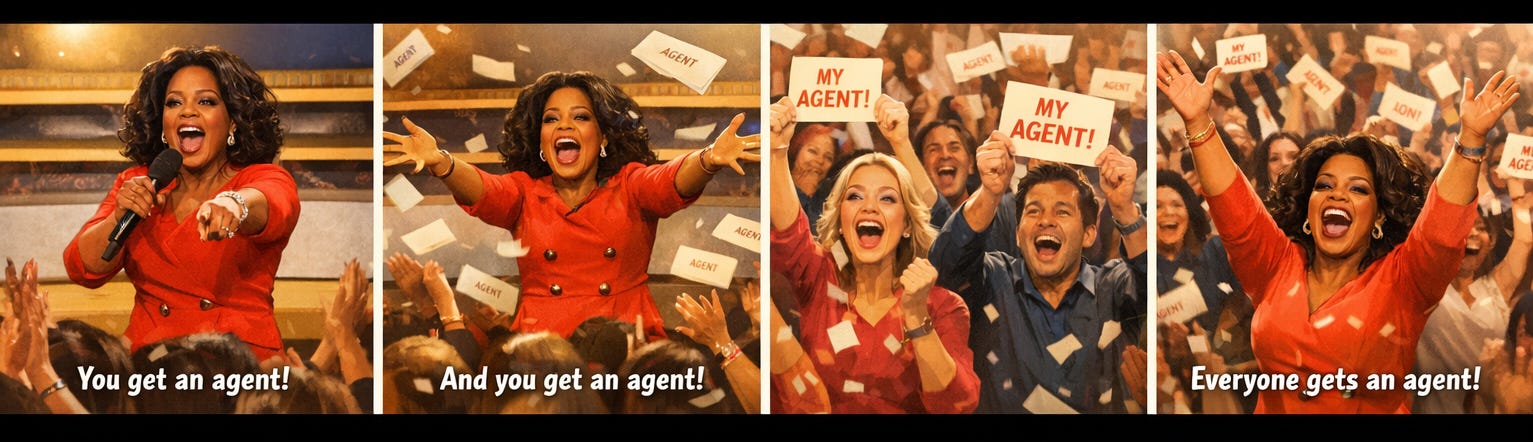
2028: Everyone Gets an Agent
By 2028, a new category has emerged that nobody expected to scale this fast: personal AI agents. Not chatbots. Not assistants. Not copilots.
Agents — entities that understand who you are and operate on your behalf in the world.
It starts with a real conversation, a short 30 minutes, where for the first time, a system listens the way a great mentor listens. It understands not just what you've done, but how you think. What drives you. Where you're growing. What you'd be great at that you haven't considered. Your strengths that come so naturally you don't recognize them as strengths. Your blind spots that no resume has ever captured.
And then it represents you. Continuously.
Across every professional context — jobs, partnerships, advisory roles, collaborations, investment opportunities — without you having to perform for each one separately.
A founder's agent doesn't blast 200 cold emails to investors. It understands the founder's vision, stage, and what they actually need beyond money. It communicates with investor agents across the network — not pitching, but representing. When both agents surface strong alignment, the humans meet. Not for a pitch. For a conversation between two people who already know they should be talking.
A company doesn't issue an RFP and review twenty proposals from firms performing their capabilities. Its agent communicates the real need — scope, timeline, constraints, cultural fit — to the network. Vendor agents that genuinely align surface themselves. The proposals aren't performances. They're informed representations.
A professional isn't just matched to full-time roles. Their agent surfaces freelance projects, advisory opportunities, teaching engagements, research collaborations, co-founder matches — across every dimension of their professional life. Not because they searched. Because their agent is always representing them, and the network is always listening.
Cold outreach dies. Gatekeeping weakens. Markets become bilateral. The hours we spend searching, pitching, performing, and "networking" begin to dissolve — not because technology automated the search, but because representation eliminated the need for it.
2035: The World That Emerges
By 2035, the shape of professional life has changed in ways that would be unrecognizable to someone from today.
Most knowledge work — the kind that filled eight-hour days with emails, reports, analyses, status updates, and meeting prep — is handled by agents. A professional might spend two hours a day in active work, and those two hours are the highest-leverage hours imaginable. Decisions their agents have prepared them for. Conversations their agents have arranged. Creation their agents can't do. Relationships their agents have surfaced but only humans can deepen.
This isn't unemployment. This is the most productive humans have ever been, per hour of human attention.
The concept of a "career" — a single employer, a title, a ladder — fades. You don't have a career. You have a portfolio. Full-time roles, advisory gigs, consulting projects, mentorship, teaching, investing — all running in parallel, all managed by your agent. Everyone is an entrepreneur. Not in the Silicon Valley sense. In the oldest sense — like a farmer who owns their own land and decides what to grow.
Managing agents becomes the new literacy. You talk to your agent. You tell it what matters. You course-correct. You build trust over time. Your agent gets better the longer it knows you — learning your patterns, your preferences, the difference between when you're excited and when you're being polite.
And your agent doesn't just represent you to the world. It represents you to yourself. It knows your patterns — when you're avoiding hard conversations, when you've set a goal and quietly abandoned it, when you're rationalizing inaction. It surfaces the right knowledge at the right moment. It bridges the gap between knowing and doing. Today, only people who can afford great coaches get this kind of support. In the representation economy, it's infrastructure.
Beyond Dollars
The representation economy doesn't just restructure how people find opportunity. It restructures how we value what people do.
Today, human contribution is measured almost exclusively in dollars. Your salary. Your revenue. Your valuation. These are the scorecards of the performance economy — and they were always reductive. They couldn't measure the mentor who changed someone's trajectory. They couldn't measure the open-source developer whose code runs half the internet. They couldn't measure the community organizer who made a neighborhood functional.
Dollars measure transactions. They've never been good at measuring impact.
The agent network makes something new possible: granular, verified, continuous measurement of human contribution across dimensions that money was never designed to track.
Economic contribution — the work you do, the decisions you make, the knowledge you share.
Societal contribution — the mentoring, teaching, and community building that holds civilization together.
Environmental contribution — the impact on the shared systems we all depend on.
Not as a replacement for currency. As a complement. The things that make life meaningful — that the market has always treated as externalities — finally have a ledger. And that ledger belongs to you.
When helping others is visible, verified, and valued, the incentive structure of society shifts. Not through regulation. Through architecture. Your mentorship accrues to your identity. Your introductions compound as signal. A society where helping others is structurally rewarded doesn't need saints. It just needs a system that recognizes what was always true: the people who invest in others' success tend to be the most capable, most connected, and most valuable people in any network.
A society where helping others is structurally rewarded doesn’t need saints
The Global Rebalancing
This restructuring doesn't stay local. When a developer in Nairobi is represented with the same fidelity as one in San Francisco — when credential, pedigree, and geography stop being the filter — talent flows where it belongs. The agent layer is the great equalizer, not because it's fair by design, but because it's efficient. And gatekeeping is inefficient.
Developing economies don't need to "catch up." They need representation.
And as cognitive AI matures, physical AI follows. Warehouses, construction sites, farms, logistics — physical labor gets its own agent layer. The farmer doesn't plow the field. They manage the fleet that does. The construction worker doesn't carry the load. They direct the systems that build. The same pattern repeats: not replacement, but reallocation. Humans move from doing the work to directing the work.
What It Means to Be Human
Each of the three great transitions freed humans to be more human. The first freed us from subsistence farming. The second freed us from industrial labor. The third frees us from knowledge busywork — the last category of work that machines can do better.
What's left when the busywork is delegated, when representation is universal, when contribution is valued beyond dollars?
What's left is the most human version of work we've ever had. Creating things that don't exist yet. Making decisions that require judgment, not just data. Building relationships that agents can surface but only people can deepen. Caring for each other in ways that compound far beyond anything a spreadsheet could capture.
The irony of the representation economy is that by putting AI between humans, we get more genuine human interaction, not less. Because the AI handles the performance — the filtering, the positioning, the market mechanics — the humans are free to just be human when they finally connect.
The third transition isn't coming. It's here. The question isn't whether this world arrives. The question is whether, when it does, everyone has representation — or whether we leave most of the world alone with a resume and a prayer.
 | A guest post by
|